
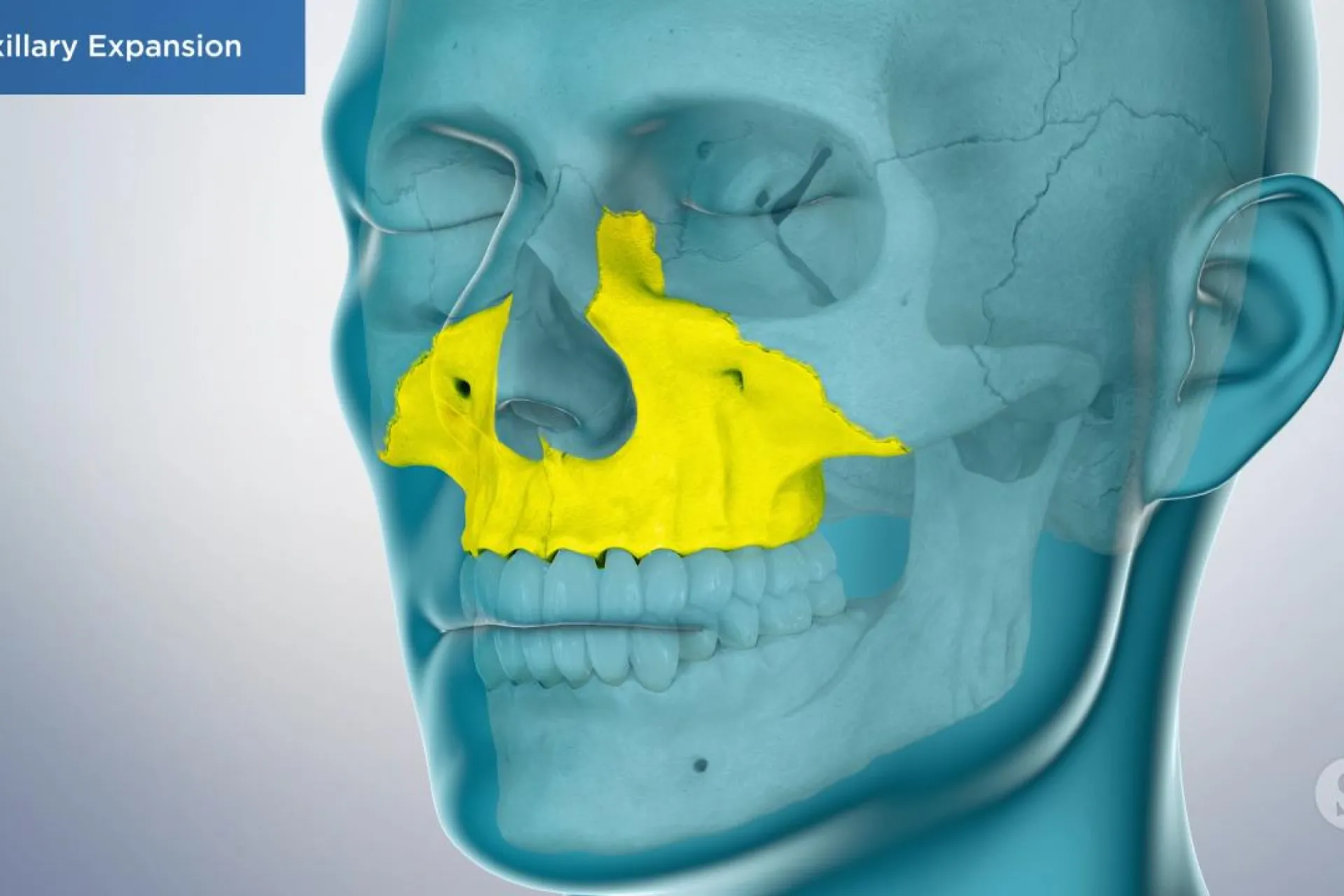
Maxillary Expansion
Your upper teeth sit in a boney structure called the maxilla or maxillary arch.
The maxilla consists of a right and left segment that fuse together in the middle of the roof of the mouth, or palate, at the midline suture.
The palate forms the roof of the mouth and the floor of the nasal cavity.
Sometimes the maxilla does not develop properly during childhood and the palate doesn’t widen as it should.
If the maxilla is too narrow it can misalign teeth and restrict breathing.
Other potential signs of a narrow palate include tooth wear
Having crowded teeth or a crossbite
Impacted teeth
Septal deviation
Mouth breathing
And snoring
There are ways to expand the maxilla; however, due to a mature skeletal structure, adults are often beyond the scope of traditional orthodontics commonly used on growing children.
Instead, your doctor may recommend one of several procedures that can gradually widen the maxilla to simultaneously treat your smile, function, and possiblyvimprove your airway and sleep quality.
There are both surgical and nonsurgical techniques to widen the palate, but in essence they all work in a similar manner.
By separating the midline suture, which causes new bone to form in the maxilla, thus widening it over time.
Some procedures use metal expanders and mini screws while others move bone using plates and wires to safely move teeth into ideal position.
These advanced procedures may require an interdisciplinary team, often consisting of an orthodontist and an oral surgeon, who work together to develop a personalized treatment plan.